Threads of India — Dr. Rajshree Verma Writes
Chanderi: The Beauty of Lightness — Episode 3
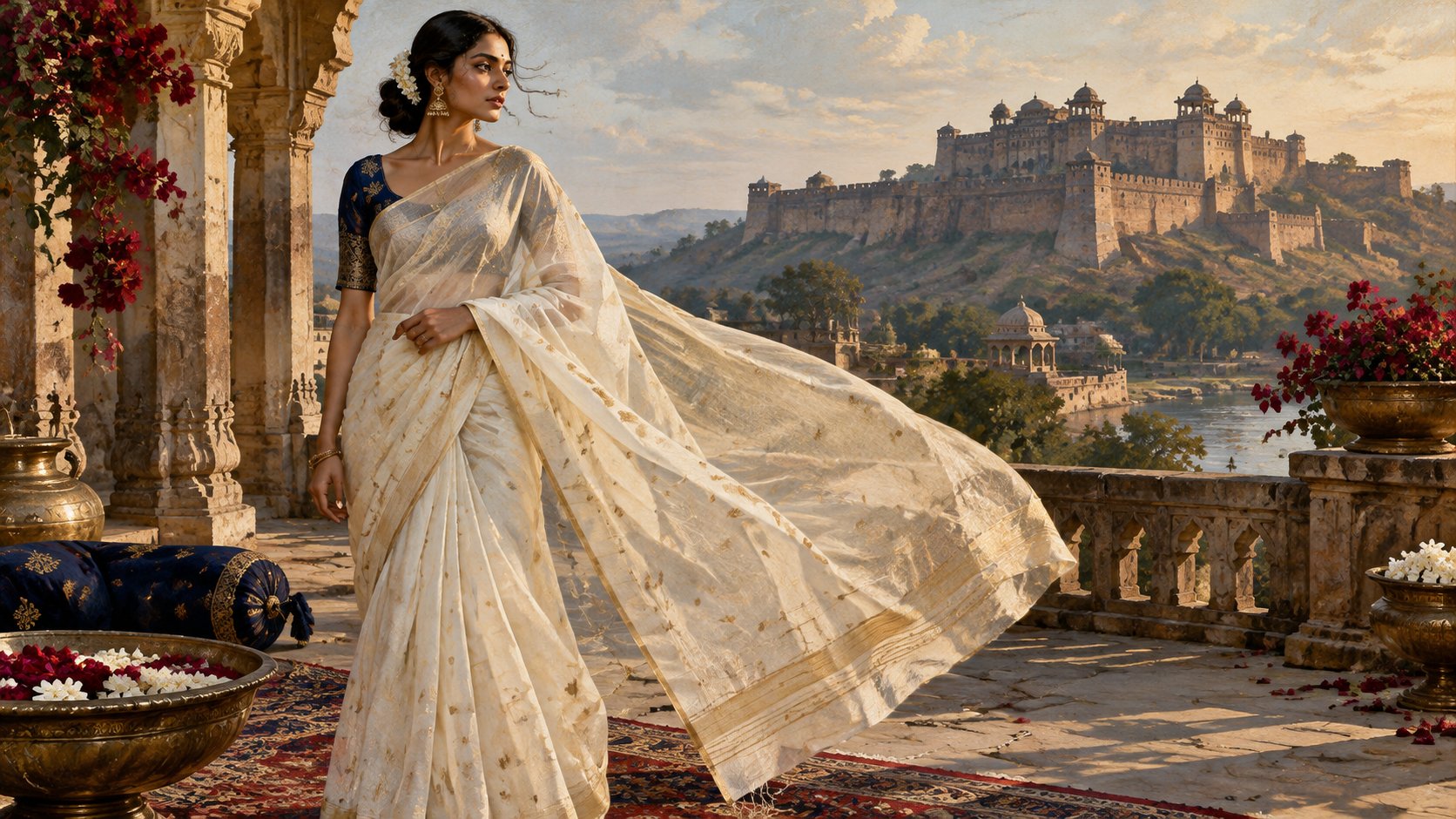
Episode 3 of Threads of India travels to Chanderi in Madhya Pradesh, where weavers create sarees celebrated for their lightness, sheer texture and delicate buti.
Threads of India Spotlight | Episode 3
Sunday, 18 October 2026
In Episode 1 we stood before the temples of Kanchipuram. In Episode 2 we walked the ghats of Varanasi, where brocade carries the weight of gold. This week our journey turns in the opposite direction — towards a textile admired not for its weight, but for its lightness.
We travel to Chanderi, a historic town in Madhya Pradesh, whose sarees are often described as being as light as air.
A Town Known by Its Cloth
Chanderi is a small town in the Ashoknagar district of Madhya Pradesh. [2] Its hills, old fort and stepwells give it a sense of history, but for many people across India the name "Chanderi" first means a saree.
That connection is officially recognised. "Chanderi Sarees" is a registered Geographical Indication in India, with its certificate dated 28 January 2005. [1] A Geographical Indication links a product's qualities and reputation to the place it comes from. [3] In simple terms, the name tells you where the cloth belongs.
What Makes Chanderi Feel So Light?
The first thing most people notice about a Chanderi saree is how it falls. The fabric is fine and sheer, with a soft sheen that catches light without becoming heavy.
This character comes from the fineness of the yarns and the skill of the weaving. Chanderi weaving is generally associated with silk, cotton, and combinations of the two, often with zari used for borders and small motifs. Each choice of yarn changes how the fabric feels — crisper, softer, more transparent or more lustrous.
For a reader learning about textiles, Chanderi teaches an important lesson: luxury is not always about richness of ornament. Sometimes it lies in restraint — in a cloth so finely made that its beauty is felt as much as seen.
The Language of Buti
Chanderi sarees are well known for small motifs, called buti, scattered across the body of the fabric. These may be floral, geometric or inspired by everyday and natural forms. Borders are usually slim and refined, and many sarees carry a gentle contrast between a pale body and a richer border or pallu.
Because the base fabric is so delicate, the motifs must be woven with care. Too much density and the lightness is lost; too little and the design disappears. The balance between open ground and ornament is part of the weaver's art.
A Living Weaving Community
Like every tradition in this series, Chanderi is not only a fabric. It is a community of weavers, dyers, designers and families who keep the knowledge alive. Techniques, colour sense and motif vocabulary pass from one generation to the next, often within households.
Accounts of how far back Chanderi weaving goes, and which royal or historical patrons shaped it, vary from source to source. Many of these are cherished community narratives. I prefer to share them as stories that matter to the people who tell them, rather than as a single settled history.
How to Appreciate a Chanderi Saree
When you hold a Chanderi saree, notice three things:
- The fall. A good Chanderi drapes softly and moves easily.
- The sheen. The surface often has a quiet glow rather than a heavy shine.
- The motifs. Look at how neatly the buti sit within the sheer ground.
The registered GI is a reminder to buy thoughtfully and to value cloth that genuinely comes from its home region. [1]
Why Chanderi Matters Today
Chanderi suits the way many Indian women dress today. It is graceful enough for celebrations and light enough for warm days, for work and for travel. It shows that heritage textiles are not museum pieces. They can belong to everyday modern life.
A Thread to the Next Episode
From the lightness of Chanderi, next Sunday we travel south-west to Maharashtra, to a saree known for brilliant colour and peacocks woven in silk and gold — the Paithani.
Threads of India is an editorial series. Kauseyam does not claim ownership of, or exclusive rights to, any tradition described here.
— Dr. Rajshree Verma Founder & Director, Vermaverse OPC Private Limited; Founder — Kauseyam
References
- [1] Intellectual Property India — Chanderi Sarees, GI Application No. 7 (registered; certificate dated 28 January 2005)
- [2] District Ashoknagar, Government of Madhya Pradesh — official district website (Chanderi lies in this district)
- World Intellectual Property Organization — Geographical Indications (what a GI protects)
Episode 3 · Chanderi · Chanderi sarees · Madhya Pradesh · Handloom · Weaves of India
View Archive