Threads of India — Dr. Rajshree Verma Writes
Banarasi Weaving: The Timeless Brocade Heritage of Varanasi — Episode 2
Episode 2 of Threads of India travels to Varanasi, where generations of artisans have transformed silk, zari and intricate design into one of India's most celebrated weaving traditions.
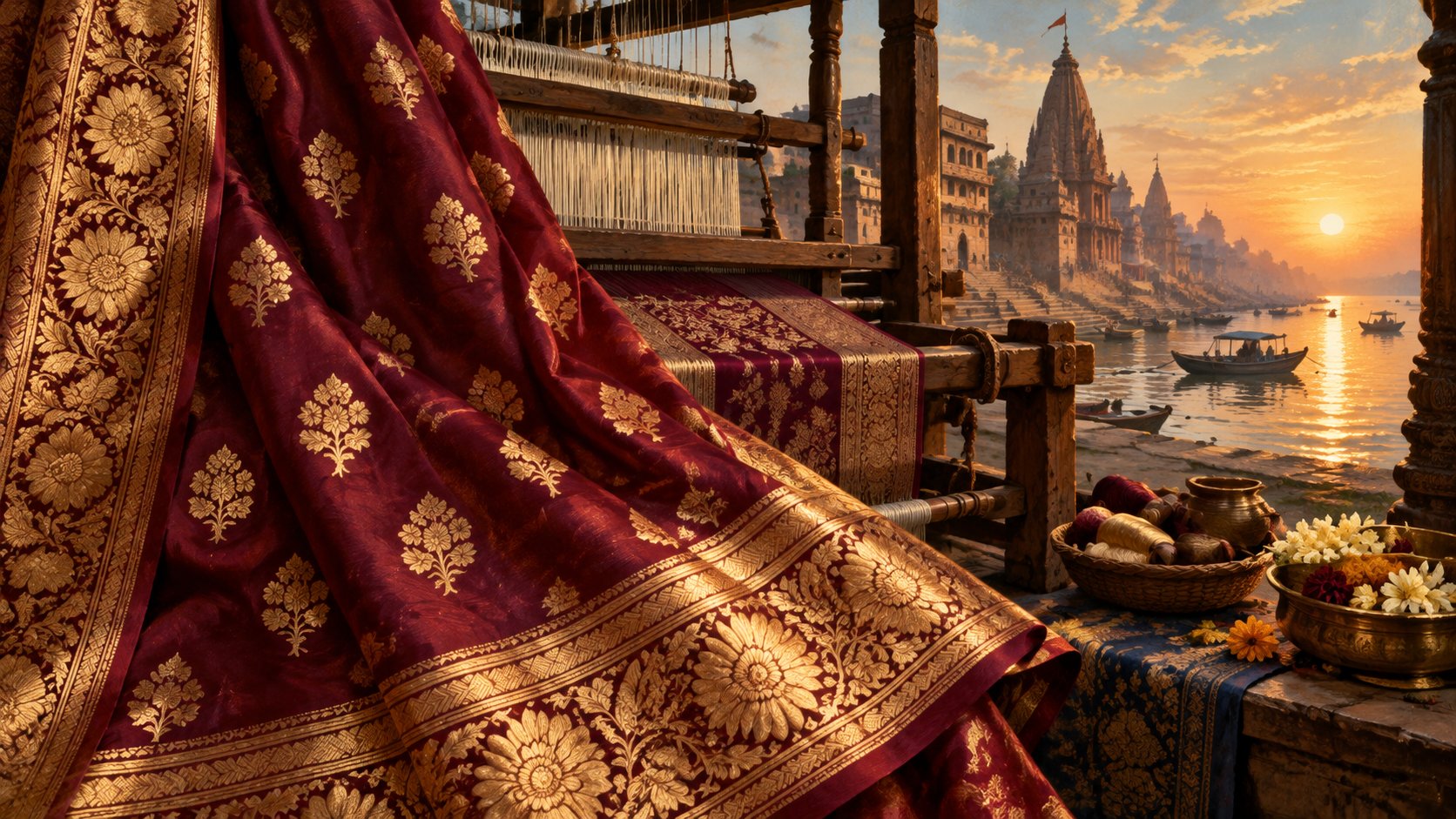
Some textiles are admired for their beauty. Others become part of a civilisation’s cultural memory. Banarasi weaving belongs to both worlds.
For Episode 2 of Kauseyam’s Threads of India Spotlight, we travel to Varanasi — also known as Banaras or Kashi — one of India’s oldest living cities and the celebrated centre of an extraordinary weaving tradition.
Here, generations of skilled artisans have transformed silk, zari, colour and intricate design into textiles renowned for their richness and refinement.
The Banarasi saree is therefore more than an occasion garment. It represents a living ecosystem of weavers, designers, dyers, yarn workers, traders, craftspeople and families through whom textile knowledge has travelled from one generation to another.
This Sunday, we enter that world.
Varanasi: Where a City and a Textile Tradition Meet
Varanasi occupies a remarkable place in India’s cultural landscape. Its ghats, temples, narrow lanes, music, spirituality and artisanal traditions have shaped the identity of the city for generations. Among its most celebrated crafts is the weaving of luxurious silk and brocade textiles associated with Banaras.
The history of Banarasi weaving is layered. Different phases of Indian history brought changing aesthetic influences, materials, techniques and patronage. Over time, weaving communities of the region developed a distinctive textile vocabulary in which Indian artistic traditions interacted with floral, geometric and courtly design influences.
This long evolution is important. Banarasi weaving should not be understood simply as a style that appeared at one particular moment. It is better understood as a living textile tradition shaped over generations through craftsmanship, cultural exchange and continual adaptation.
The Beauty of Banarasi Brocade
One of the defining characteristics associated with Banarasi textiles is their elaborate woven ornamentation. Rather than merely printing a decorative design onto finished cloth, traditional brocade weaving can create motifs within the structure of the textile itself through supplementary threads.
Silk provides the luxurious foundation. Zari and supplementary yarns create ornamentation. The loom becomes the place where the design gradually emerges. Depending upon the technique and design, an artisan may spend considerable time producing an intricately woven textile.
This is why a fine Banarasi saree deserves to be examined closely. From a distance, we see splendour. Up close, we begin to see the intelligence of the weave.
Kadhua: Motifs Woven Individually
Among the techniques closely associated with fine Banarasi weaving is Kadhua, or Kadwa weaving. In this painstaking technique, individual motifs can be woven separately rather than being produced through a continuous supplementary-weft pattern across the entire width.
The result can be exceptionally clean and intricate motifs. But this refinement requires something precious: time. The artisan must carefully build the design while maintaining the structure and rhythm of the textile.
It is an excellent reminder that handmade luxury is not defined simply by expensive material. Its deeper value lies in human skill, time and accumulated knowledge.
The Visual Language of Banaras
Look carefully at a traditional Banarasi textile and you enter a remarkable world of motifs. Among the design forms commonly encountered in the broader Banarasi vocabulary are:
- Buti — small individual motifs distributed across the textile field.
- Buta — larger and more elaborate versions of decorative motifs.
- Bel — flowing creepers, vines and floral arrangements that can create rhythmic movement through the textile.
- Kalga — an elaborate floral or paisley-like decorative form frequently associated with the rich ornamental vocabulary of Banarasi textiles.
- Jhallar — decorative elements often seen near the border area, helping visually connect the main field with the border and pallu.
Floral forms, leaves, paisleys, geometric arrangements and other stylised motifs together create a visual vocabulary that has continually evolved. The saree thus becomes a surface on which generations of artistic memory are rewritten.
The Radiance of Zari
For many people, the first impression of a Banarasi saree is its luminosity. That visual richness is closely connected with the use of zari.
Metallic-looking threads woven into silk can create extraordinary interactions with light. As the wearer moves, the surface changes — sometimes glowing softly and sometimes becoming dramatically radiant.
Yet zari is not simply about brilliance. In skilled hands, it helps define borders, motifs and pallu compositions and gives architectural structure to the textile. The effect is therefore not merely decorative. It is structural, rhythmic and artistic.
The Loom as a Place of Knowledge
A loom may appear to be a mechanical arrangement of threads. For a master artisan, however, it is a language. The weaver must understand the behaviour of yarn, tension, colour, pattern and structure. A small error can disturb an intricate motif. A subtle change in tension can affect the surface of the cloth.
Producing a complex Banarasi textile therefore requires much more than operating a loom. It requires judgement developed through experience. Some forms of textile knowledge can be written down. Much of craft knowledge, however, lives in hands, eyes and repeated practice. That makes the artisan an essential bearer of cultural knowledge.
The Saree Is Never the Work of One Pair of Hands Alone
When we admire a completed Banarasi saree, we naturally focus on the finished textile. But behind that textile exists an entire ecosystem. Depending upon the production process, different specialists may participate in designing, preparing yarn, dyeing, setting up the loom, weaving, finishing and trading. Families and neighbourhoods historically associated with weaving contribute different forms of expertise.
Therefore, a saree displayed in a showroom represents much more than one commercial product. It represents a chain of human knowledge and labour. Recognising this ecosystem is essential if Indian handloom traditions are to be understood responsibly.
Banarasi Sarees and Indian Celebrations
Few textiles occupy such a recognisable position in Indian ceremonial dressing as the Banarasi saree. Its luxurious silk, elaborate motifs and zari ornamentation have made it particularly associated with weddings, festivals, religious ceremonies, family celebrations and heirloom collections.
For many families, a Banarasi saree purchased for a wedding does not end its journey after the ceremony. It may be carefully folded and preserved. Years later, it may appear again at another family celebration. Eventually, it may be passed from mother to daughter or from one generation to another. At that moment, its value is no longer measured merely by silk or zari. It contains memory.
A Heritage Protected Through Geographical Indication
The connection between Banarasi textiles and their geographical tradition has also received formal recognition through India’s Geographical Indications framework. The registered GI “Banaras Brocades and Sarees” recognises the geographical identity associated with this celebrated textile tradition.
This recognition matters. A Geographical Indication connects a product’s reputation, characteristics or qualities with its geographical origin. In traditional crafts, this relationship is especially important because the identity of the product may depend upon generations of locally accumulated knowledge.
Thus, Banarasi is not merely a decorative label. It represents a relationship between place, people, technique, knowledge and reputation.
Understanding Authenticity
The popularity of Banarasi-style textiles also creates an important responsibility for buyers. Not everything that visually resembles a traditional Banarasi handwoven saree necessarily represents the same production process. Machine-made textiles, powerloom products and handwoven textiles may differ considerably in their manufacturing methods, labour requirements and costs.
A responsible heritage conversation therefore should not reduce authenticity to appearance alone. Consumers should be encouraged to ask questions: Where was the saree woven? How was it woven? What fibres were used? What type of zari was used? Is it handloom or powerloom? Does the seller provide reliable information about its origin?
An informed buyer does more than purchase a saree. An informed buyer helps create demand for transparency.
Heritage Must Also Have a Future
Traditional crafts cannot survive on nostalgia alone. Weaving must remain economically meaningful for the people who practise it. Younger generations must be able to see dignity and opportunity in continuing craft traditions.
Design must sometimes evolve. Markets will change. Consumer preferences will change. Technology will change. But evolution does not necessarily mean abandoning tradition. The strongest textile traditions often survive precisely because they know how to adapt without losing their identity.
Banarasi weaving demonstrates this resilience. Its vocabulary can enter contemporary colours and new design contexts while retaining its connection with the loom, the artisan and the cultural landscape of Banaras.
A Saree That Becomes Memory
Imagine a Banarasi saree carefully preserved after a wedding. Years pass. Its owner opens the wardrobe and unfolds it again. The colour remains. The zari catches the light. But something has changed. The saree now carries a story. It remembers a ceremony. A family photograph. A person. A particular moment in time.
This is one of the most beautiful dimensions of Indian textile heritage. A textile begins as fibre and yarn. The artisan transforms it into cloth. Culture gives it meaning. And human life gives it memory.
Why Banarasi Weaving Matters
To celebrate Banarasi weaving is not simply to celebrate luxury. It is to recognise the extraordinary relationship between human hands and textile knowledge. It is to honour generations of artisans. It is to understand the value of slow, intricate craftsmanship. It is to acknowledge Varanasi not merely as the place where these textiles are sold, but as a cultural landscape deeply connected with their identity.
And most importantly, it is to remember that India’s textile heritage survives only when the people who carry that knowledge are able to carry it forward.
Threads of India
From the magnificent silk traditions of Kanchipuram in Episode 1, our journey has now reached the looms of Banaras. Different regions. Different techniques. Different textile languages. Yet each tells a chapter of the same extraordinary story: India woven in threads.
Next Sunday, our journey continues to another region, another loom and another remarkable saree tradition. Because every saree has a birthplace. Every weave carries knowledge. Every motif has a language. And behind every enduring textile tradition are generations of human hands.
Tradition in Every Thread. Craftsmanship in Every Weave. Heritage in Every Saree.
References
- [1] District Varanasi, Government of Uttar Pradesh — Banaras Brocades and Sarees (silk, zari, motifs and loom attachments)
- [2] Victoria and Albert Museum — Banarasi Sari, about 1850, object O77719 (supplementary-weft technique and materials)
- [3] Victoria and Albert Museum — Brocade, Varanasi, 19th century, object O77029 (kincob and wrapped zari thread)
- [4] Intellectual Property India — Banaras Brocades and Sarees, GI Application No. 99 (registered name and certificate dated 4 September 2009)
Episode 2 · Banarasi weaving · Banaras brocade · Zari · Textile heritage · Weaves of India
View Archive