
Threads of India — Dr. Rajshree Verma Writes
Patan Patola: The Patience of Double Ikat — Episode 5
Episode 5 of Threads of India visits Patan in Gujarat, home of the Patola — a double ikat silk in which the pattern is dyed into both warp and weft before weaving.
Threads of India Spotlight | Episode 5
Sunday, 1 November 2026
Every textile in this series asks something of its makers. Brocade asks for richness, Chanderi for delicacy, Paithani for colour. The Patola of Patan asks for something rarer still: patience and precision of an extraordinary kind.
This week we travel to Patan in north Gujarat.
What Is Double Ikat?
To understand Patola, we first need to understand ikat. In ikat, threads are tied and dyed before weaving, so that the pattern already exists in the yarn. When these threads are woven, the design appears.
In many ikat traditions, only one set of threads — the warp or the weft — is dyed this way. In double ikat, both the warp and the weft are resist-dyed, and the weaver must align them so that the patterns meet exactly. A tiny shift and the motif blurs.
That is why double ikat is considered one of the most demanding forms of textile work anywhere in the world.
A Registered Heritage
"Patan Patola" is a registered Geographical Indication. The applicant was the Patan Double Ikat Patola Weavers Association, and the certificate is dated 9 September 2013. [1] The registration recognises that the name belongs to this place and its weaving community. [3]
The craft is closely associated with the Salvi weaving families of Patan, who have carried this knowledge through generations. The names connected to the GI application themselves reflect this family heritage. [1]
Planning Before Weaving
A Patola begins long before the loom. The design is carefully planned, and bundles of silk threads are tied in sections and dyed, colour after colour. Each tying protects part of the thread from the dye. Untying and re-tying for each colour builds up the pattern step by step.
Only when the warp and weft are fully prepared does weaving begin — and even then the weaver keeps adjusting so that every motif lines up.
Motifs and Meaning
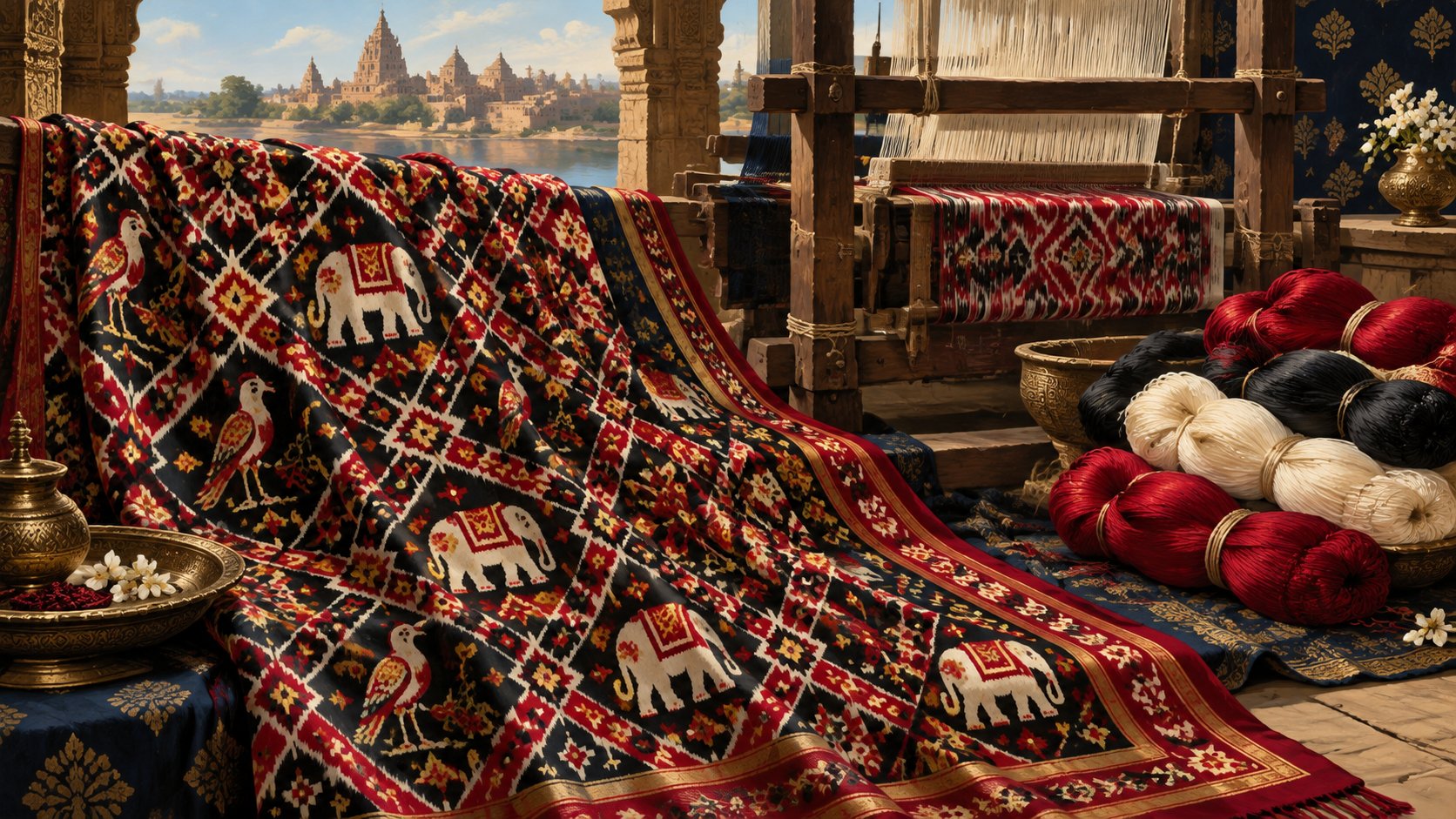
Patola designs are often bold and geometric, with deep reds, blacks, whites, greens and yellows. Alongside geometric grids, you may see motifs such as elephants, birds, flowers and figures. Because both sides of the cloth carry the dyed pattern, a true double ikat looks equally clear on both faces.
Many communities in Gujarat and beyond have treasured Patola for ceremonies and special occasions. Stories about its ancient patrons and trade routes are rich and varied. I offer them as heritage narratives rather than one fixed history.
Telling Ikat Traditions Apart
India has several celebrated ikat traditions. Next week we will visit Pochampally in Telangana, another registered ikat GI. [2] Comparing them helps us understand that "ikat" is a family of techniques, each region speaking it with its own accent.
How to Appreciate a Patola
When you see a Patola, look for:
- Clarity on both sides — the mark of true double ikat.
- Alignment — how sharply the motifs meet where warp and weft cross.
- Colour depth — rich, even dyeing across the cloth.
Why Patola Matters Today
In a world of instant production, a Patola reminds us what time and skill can create. It asks us to value not only the finished cloth but the months of human attention inside it.
A Thread to the Next Episode
Next Sunday, we stay with ikat but move south to Telangana, to the geometric world of Pochampally.
Threads of India is an editorial series. Kauseyam does not claim ownership of, or exclusive rights to, any tradition described here.
— Dr. Rajshree Verma Founder & Director, Vermaverse OPC Private Limited; Founder — Kauseyam
References
- [1] Intellectual Property India — Patan Patola, GI Application No. 232 (registered; applicant Patan Double Ikat Patola Weavers Association; certificate dated 9 September 2013)
- [2] Intellectual Property India — Pochampally Ikat, GI Application No. 4 (for comparison of ikat traditions)
- World Intellectual Property Organization — Geographical Indications (what a GI protects)
Episode 5 · Patan Patola · Double ikat · Gujarat · Silk · Weaves of India
View Archive