
Threads of India — Dr. Rajshree Verma Writes
Maheshwari: Sarees from the Banks of the Narmada — Episode 8
Episode 8 of Threads of India visits Maheshwar on the Narmada in Madhya Pradesh, home of Maheshwari sarees known for their light texture and elegant borders.
Threads of India Spotlight | Episode 8
Sunday, 22 November 2026
Our journey through the weaves of India brings us back to Madhya Pradesh — this time to the town of Maheshwar, on the banks of the Narmada river, in Khargone district. [2]
In Episode 3 we explored Chanderi, also from Madhya Pradesh. [3] Maheshwari shows how two weaving traditions from the same state can each develop a character of their own.
A Town on the River
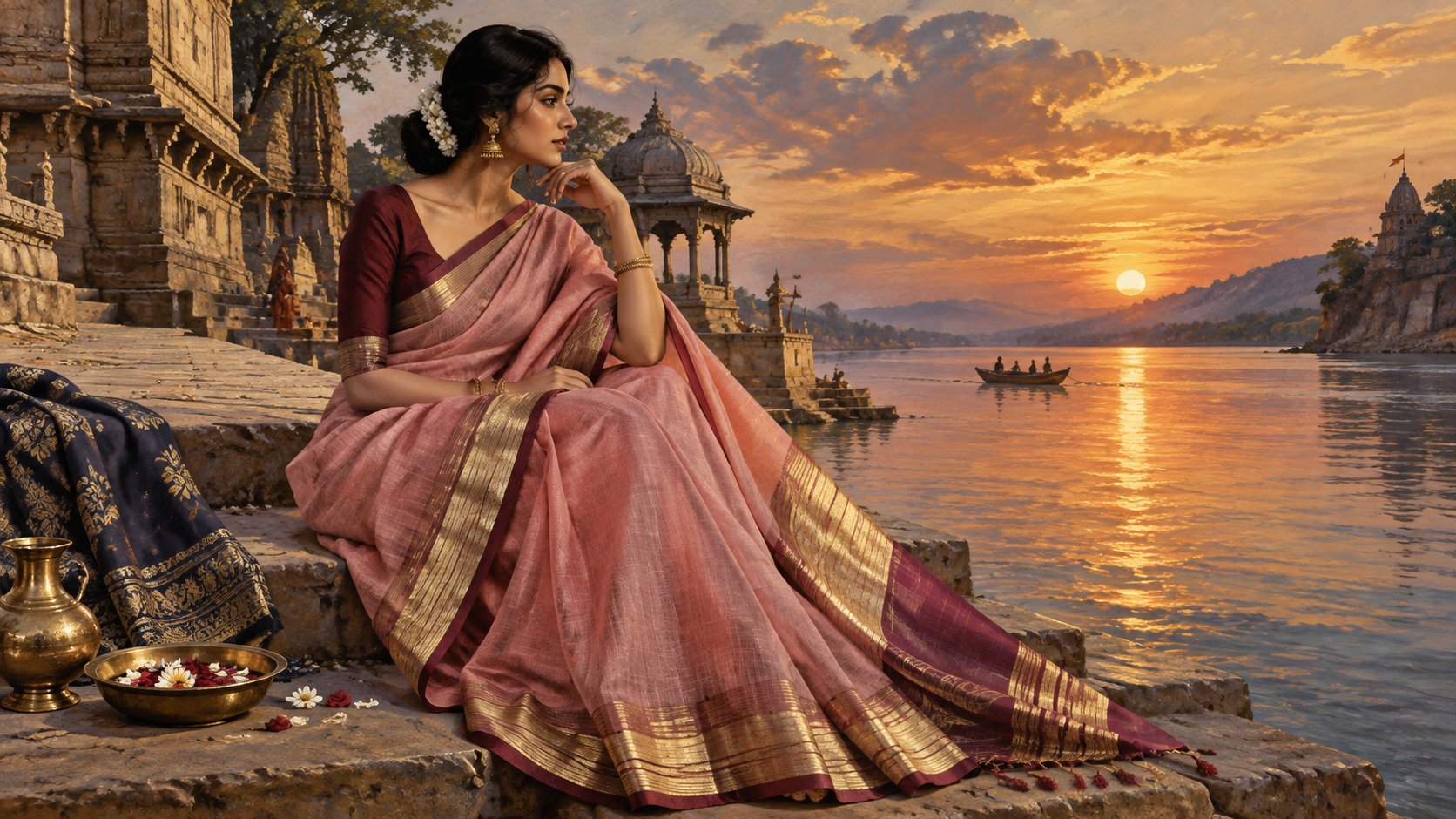
Maheshwar is known for its riverside ghats, temples and fort, and for its sarees. Watching the Narmada flow past the old stone steps, it is easy to understand why so many people describe the town and its textiles together.
"Maheshwar Sarees & Fabric" is a registered Geographical Indication, with its certificate dated 17 July 2012. [1]
The Character of a Maheshwari Saree
Maheshwari sarees are known for being light and comfortable, woven in cotton, silk, or blends of the two. They often feature plain or simply patterned bodies — stripes and checks are common — with elegant, well-defined borders, sometimes enriched with zari.
Many Maheshwari sarees are admired for their reversible borders, which look neat on both sides. This makes them easy to drape and gives them a polished finish.
Heritage and Story
The revival and patronage of Maheshwar's weaving are often linked in popular accounts to the Holkar rulers, and especially to Rani Ahilyabai Holkar, who is remembered with deep respect in the region. These are much-loved historical narratives. I share them as part of Maheshwar's cultural memory, while our confirmed facts rest on the official sources cited here.
The Weavers of Maheshwar
Like every tradition in this series, Maheshwari lives through its weavers — families and workshops who prepare yarn, set looms and carry design knowledge forward. Supporting genuine Maheshwari weaving helps keep that community thriving.
How to Appreciate a Maheshwari Saree
Look for:
- The border — its clarity, and whether it is finished neatly on both sides.
- The texture — light, smooth and comfortable to wear.
- Simple patterns — stripes and checks woven with precision.
Looking Back on Our Journey
Over eight Sundays, Threads of India has travelled from the temples of Kanchipuram to the ghats of Varanasi, the lightness of Chanderi, the colour of Paithani, the precision of Patola, the geometry of Pochampally, the golden glow of Muga and now the grace of Maheshwar.
Each tradition is different, but they share one truth: Indian textiles are living knowledge, carried by people and rooted in place. Every registered Geographical Indication we have met is a reminder to honour that link.
Thank you for travelling with me. Our threads will continue.
Threads of India is an editorial series. Kauseyam does not claim ownership of, or exclusive rights to, any tradition described here.
— Dr. Rajshree Verma Founder & Director, Vermaverse OPC Private Limited; Founder — Kauseyam
References
- [1] Intellectual Property India — Maheshwar Sarees & Fabric, GI Application No. 197 (registered; certificate dated 17 July 2012)
- [2] District Khargone, Government of Madhya Pradesh — official district website (Maheshwar lies in this district)
- [3] Intellectual Property India — Chanderi Sarees, GI Application No. 7 (for comparison with Episode 3)
Episode 8 · Maheshwari · Maheshwar · Madhya Pradesh · Handloom · Weaves of India
View Archive